The acting of teaching

I once was asked (no option, really) to spend my prep hour emergency-substituting for an absent teacher. I know this happens quite frequently these days, but it was less common at the time so of course I had a lot of tasks planned for my prep. Teaching five sections with three different lab science courses all at full capacity (~35 students each) will make those daily prep hours seem like lifelines.

Anyway, I was especially not thrilled because this particular class of freshmen had a sort of laissez faire teacher who didn’t bother much with classroom management; the students were used to pretty much doing whatever they wanted and things could get wild in there. Of course, I could find no seating chart at the teacher’s station and the lesson plan for the day was a well-worn video with fill-in worksheet.

I knew my normal chill vibe was not going to cut it here. I had no relationship with these students, and they were anticipating even more freedom than usual with a sub in the room. I needed to channel an alter ego to make any progress with this group, like maybe the love child cross of Mary Poppins and Clint Eastwood.

Nope, no bathroom passes. No, you can’t move from your seat. Wake up, find a pencil, hush up, get your worksheet ready, here we go with this riveting film!

I am no expert on the film’s topic, but happily I know more than the 9th graders. And I can see what information they need for the worksheet, so I do my usual thing and hit the pause button regularly to start asking questions, or checking in on their understanding, or pretending to get confused and talking through the problem. We make sure everyone has heard the critical information they need to answer each question on the worksheet before proceeding with the video. Pretty soon, students are participating! They are answering my questions, helping each other, and paying attention to the assignment.

I have been the grumpiest, sternest version of myself with these students, but I have not abandoned them. At the end of class, everyone turns in their work and they don’t seem to resent having a calm, productive day. Several of them ask if I can come back and be their teacher!

It has gone better than I expected. I think about this. Students don’t want an out-of-control classroom, no matter how hard they seem to work to have one. They would actually rather have a grumpy strict teacher than one who lets everyone just goof off all day. They want to learn. They want teachers who show them that the material they are learning is worth their time.

If we – subject-area experts, at the secondary level – don’t seem interested in what we are asking students to do, how can we expect them to be? I know that if I had popped the video into the machine, handed out the worksheets, and let it run while I tried to grade papers, the class would have had an entirely different reaction and the student experience would have been completely different, even given the same exact assignment. Our enthusiasm and how we design each class day’s interactions makes a world of difference.

Sometimes it can be hard to maintain that energy as a teacher. One year, I was assigned only one course so I taught the same lesson five times in a row each day. It was like a year of performance acting, keeping that spark of enthusiasm still lit for my 7th period class, who deserved the same excitement that my first class of the day received. Teaching takes so much physical and mental energy, and this is one of the reasons why.

If I were in charge of teacher preparation programs, I would add an acting class to the required curriculum. It would be great for people who maybe haven’t stood up in front of an audience before, or might need practice adjusting voice projection or physical presence. It’s important to be your authentic self as a teacher, but there is also a performance component that can be very helpful to master. The ability to access, draw out and present appropriate aspects of our selves to students, together with thoughtful lesson design, makes us more effective in our roles as teachers.


Music can be magic in science class

When I was a young twenty-something, my ultra-cool dad gifted me a pair of speakers because he was updating his system. This was back in the days when speakers were not cute little orbs and cylinders that fit in the palm of your hand, but massively heavy, solid wood constructions that could be used for seating in a pinch. I could barely wrestle them into my car to carry them back to Phoenix from Berkeley, but I was determined because they sounded so goooood.

A few years later, when I graduated from Arizona State University’s teacher certification program and got my first teaching job, my department chair handed me the keys to my very own classroom. One of the first things I did was to drag those speakers into that room and hook up a great sound system with a great old used amplifier and CD player. Later I added cables so I the system would play songs from my iTunes account.

Looking back, I can’t say I had a big pedagogical plan for using those speakers. Or any plan really, other than liking to work to music and knowing that teenagers like music too. I knew I would be spending a lot of time at school, and I wanted to have my music to keep me company. And those old-school speakers could handle a big classroom/lab situation – heck, they could probably rock the whole science wing if I cranked them way up!

Over time, though, I started to realize what a great teaching tool that sound system could be. The first thing that occurred to me was that I could help the students get to know me, and start to build a welcoming space, through my playlist. Of course, my music selection was school appropriate, but also eclectic. I gathered a collection including some “oldies” from my high school days, the alternative/folk tunes I now liked, some Scandinavian and some Disney tunes, some of my daughter’s favorite K-Pop hits, and some Arabic and African songs that I heard on NPR’s World Music Café. I tried to surprise my students by sprinkling in some current hits when I could. The best choices were either calming or upbeat, so that I could play music while they worked independently, or more often, in groups on labs and investigations.

As a new teacher devoted to inquiry learning, of course I had some plans to have my students work collaboratively starting with the first day of class. But we didn’t have our classroom community established yet, and when I put the students into groups the room was still awkwardly silent. Not happy with that situation, I decided to play some music softly while they worked. The effect was like magic – immediately my students all started talking with their partners and the atmosphere in the room transformed from stressful to comfortable.

My next insight followed quickly, when I wanted to check in with my students while they were working on their task. Rather than trying to talk over the music, I walked over and turned it off for a moment. Every student stopped what they were doing and looked up to see what happened. More magic: a simple way to gather class attention without saying a word!

After the first week of class, I was a believer in the use of music in the classroom. And over the years that followed, music brought so many moments of connection with my students:

  • The times that students suggested new artists or created special CDs for me to enjoy and play in class, based on the music they knew I liked
  • The many times we had class sing-a-longs while we worked, when a classic Disney tune or another song everyone knew came up (Journey’s “Don’t Stop Believing” and Neil Diamond’s “Sweet Caroline” were always hits)
  • The times I found a couple of my students singing along with Arabic songs I had added to my playlist, then discovered that they spoke Arabic at home. (I asked them to make sure the songs’ subjects were school-appropriate for me!)
  • The year I had an exchange student from Africa, and his joy and pride upon hearing a song in his own language
  • Students asking to “DJ for the day” and play their own favorites during a lab day
  • One year I had a student who absolutely loved the blues and could identify almost any song within seconds. I had fun downloading new tunes to try and stump him but never could.
  • The day a tuba player in our school band brought a CD full of tuba classics to share

There were so many times that music was an asset in my science classroom, but it wasn’t always playing. For example, many students needed absolute quiet during assessments, so we never played music during formal assessments. If an activity was especially chaotic in its own right, we didn’t need the added stimulus of music. And the music was always silenced if anyone was addressing the class.  But we are fortunate to have many occasions in science class when students are working independently while investigating, constructing, taking measurements, or analyzing, and when used judiciously, music can be a wonderful tool for proactive classroom management and building community.

Interested in hearing more? Here are some ideas from other teachers who have found success using music in their classes:

https://www.scienceinschool.org/article/2007/music/

http://frequencyoflearning.com/john-hopkins-study-integrating-music-in-the-classroom/

https://www.edutopia.org/article/3-ways-use-music-classroom

And here’s an interesting article about using music to reduce stress that may have some relevant tips:

https://www.anxiety.org/music-therapy-stress-reducing-playlist

Wondering about copyright issues? I always used music I had purchased, so I felt like I wasn’t in violation to play it in an educational (not-for-profit) situation. Still, I was happy to read this abut U.S. copyright law: Rob Kasunic, principal legal advisor for the U.S. Copyright Office, cites Section 110, which allows for “performance or display” of copyrighted works “in the course of face-to-face teaching activities of a nonprofit educational institution.” This exemption, for example, makes it permissible for teachers to play prerecorded music in their classrooms as part of the teaching activity. https://nafme.org/my-classroom/copyright/copyright-law-what-music-teachers-need-to-know/

Asking Students to Question

In my last post, I talked about how thoughtful use of teacher questions can really help to liven up a classroom. Another, maybe even better, strategic choice is to get students to ask the questions.

If you go this route, the risk of failure is a little higher. As we know, it’s not so easy to write great questions, so this is actually a big ask for students. Freezing up is a common response, or maybe a small list with not-so-relevant questions, or even some good contributions but only by a very few voices.

What we need is a catalyst and some unpacking of the question-generating process to help students succeed. One great structured method I’ve found to be highly useful with students is the Question Formulation Technique (QFT), which has an organized brainstorming format with a few simple but powerful steps that help student teams formulate questions and then reflect on their quality and usefulness for inquiry. Through this work, students work collaboratively to identify and generate both open-ended and closed-ended questions. The process is simple and easy to adapt for any subject area and grade level. To visualize how QFT can work in a science classroom, check out this great 9th grade physics class video example.

Even with a question-generating strategy like QFT, student engagement is not guaranteed. You need some kind of inspiration to engage student interest and kick-start their thinking. It doesn’t have to be complex; it can just be a new look at some object or idea that they would normally take for granted, or a visual or mental puzzle. Starting out with an intriguing story or phenomenon related to the concept(s) at hand is a great way to inspire student questions. So great, in fact, that folks like the experts at Ambitious Science Teaching (AST) and of course the Next Generation Science Standards (NGSS) recommend starting every unit with an “anchoring phenomenon.” The phenomenon inspires student curiosity and questions, which can be used to drive inquiry and learning as a storyline of science concepts are pursued to develop explanations and pursue answers. There are so many helpful resources on the AST website, especially the suggested routines for encouraging students to express their thinking through scientific discourse and embedded strategies for formative assessment as you are able to hear and see their developing ideas and thoughts on a daily basis.

You might be thinking that redesigning your whole curriculum to fit this structure is really complex work, and you can’t change everything about the way you teach overnight. This is SO TRUE.

But — you can also use phenomena and intriguing stories on a more micro level, to introduce and spark student interest and questions about a concept rather than a unit. For example, I used to start my photosynthesis unit by asking students, “What do plants eat?” (encouraging them to think of examples of large plants, like trees) followed by the story and clues of how scientists figured this out. But now I think it might be more interesting to show them a video like this one, and then let them ask questions using QFT to see what they are curious about. Probably something will come up that will bring us around to the concepts we’re required to learn, but this time the curiosity will originate from the students rather than my script — and the class discourse will be much more engaging.

Resources are starting to become more available so you don’t have to re-invent the wheel – check out the (searchable) cool images and ideas at https://www.ngssphenomena.com/ as well as the work being done by Paul Anderson here: https://thewonderofscience.com/phenomenal. Choose your next concept, or a future less-than-exciting one, and see what ideas might perk your students up and start an interesting conversation in class!

Leveraging questioning and intriguing phenomena by combining them in creative ways can transform a class, making it more interesting for everyone. The more we can step off the stage and ask students to contribute their ideas, questions and wonderings, then introduce our science curriculum as a useful tool in response, the more meaning our science class will have for all concerned. It can seem a little risky, and some days will succeed better than others, but it’s a journey your students will appreciate. It makes every day more interesting and exciting from a teaching perspective as well.

Permission to Fail — In Order to Soar

We need to give ourselves permission to fail, right alongside our students. Because if we don’t risk trying and failing, we aren’t really stretching and growing. Madeline Hunter* had a quote for this:

If you want to feel secure, do what you already know how to do. If you want to be a true professional and continue to grow… Go to the cutting edge of your competency, which means a temporary loss of security. So whenever you don’t quite know what you’re doing, know you’re growing.

It’s hard though, to risk failure. Maybe this is why, in so many science classrooms, I have seen students working their way through predictable textbook worksheets, or following direction after direction in the lab to get to a foregone conclusion (the teacher has even told them what they should see at the end). Science teaching reform efforts have been underway since before I started my teaching career in the late 1990’s, and they continue to this day. It can be scary to teach using methods so different from the ones we experienced, to turn over more agency to the students. What if they don’t learn what you intend? What if the class ends up somewhere you didn’t predict?

Maybe students aren’t learning that much anyway, when we’re playing it safe. How are they doing on our assessments? How long will they remember what we’re teaching? Given the firehose blast of teaching responsibilities, every day in our classrooms just can’t be perfect. But is there a way to make science more engaging, so students are bringing their own thoughts and experiences to the party? What can we do to inspire them to argue (about science!) with their partners, or to contribute a new idea to their team, or to keep thinking about these ideas after the bell rings? And can we do this without adding too much to our already overloaded plates?

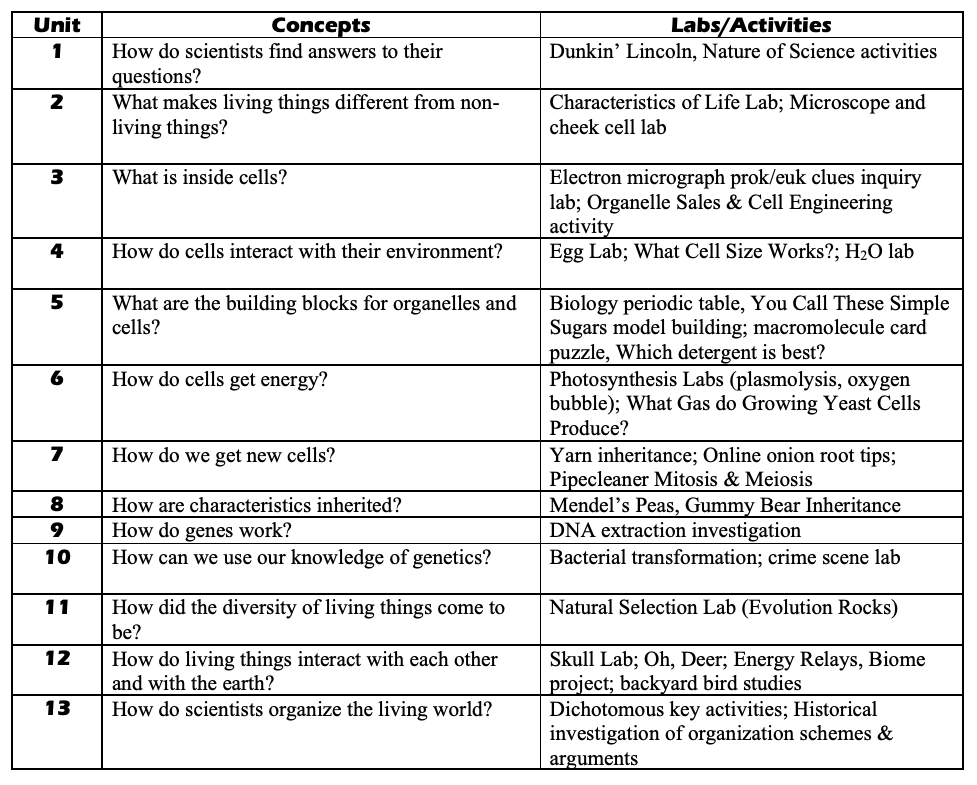
Many experts recommend starting with questions as a technique that can help. Essential questions invite genuine, complex and ongoing inquiry. As a young teacher, I gradually recognized the value of starting my units with questions as I tried to help my students experience the process of doing science. I read up on essential questions and worked on writing them to guide each of my units throughout the year, eventually ending up with this list:  

Table with curriculum plan for biology course; unit Essential Questions and ideas for inquiry activities for each are listed.
Year plan with unit Essential Questions and ideas for hands-on inquiry activities to help students
understand the concepts needed to answer the questions

Sadly, I found that my technically “essential” questions did not always perk up the interest of my students. I had to do a little more work to identify strategic questions that would connect these ideas to students’ everyday life, or challenge their assumptions when introducing the day’s work. Starting the day with such a question can help focus students on the why of what we are learning. This takes a bit of thinking and planning, but once you come up with a good question, it will work its magic over and over. One year I changed forever how I introduced my unit on cellular respiration by coming up with this little sequence of discussion questions to start the day: 

How long can you live without food? – discussion ensues; they bring up examples of fasting and hunger strikes that they have heard of etc.; we decide a month or so, depending –

How long can you live without water? – more discussion, arrive at a week or so, depending –

How long can you live without oxygen?  – students think about holding their breath, diving underwater etc. I prompt for further thought of how long once no more oxygen is circulating in the body? We agree on definitely minutes, likely a minute or so –

Now for the kicker question that will really be important for this unit: Why do we need oxygen so badly? What do we do with it? – no one knows this, they just say “so you won’t suffocate” but no one really knows why oxygen must be present in the air we breathe –

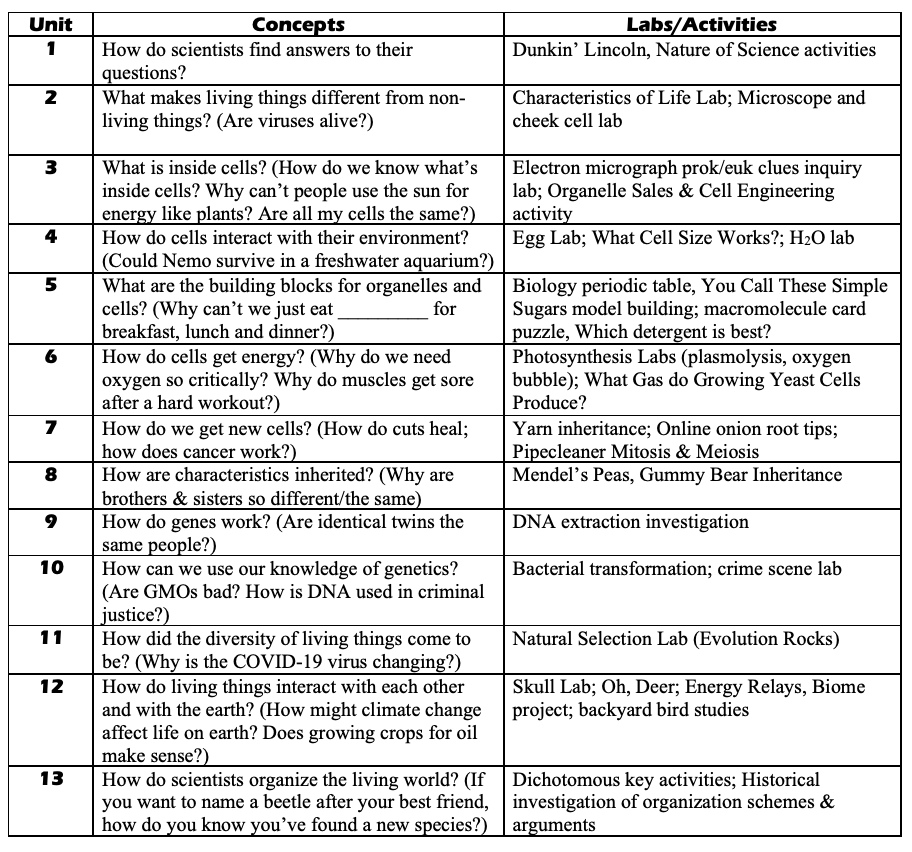
Now I have them: we’re about to learn why oxygen is so critical to our survival, and even how it changed life on earth! By the end of the unit, they will be able answer that last question with confidence. Now we have a real-world focus for learning about some very abstract concepts, which helps the work ahead seem worthwhile. You’ll see some more examples of these types of strategic questions identified in parentheses after the essential questions in the revised table below:

The year plan table with strategic focus questions added in parentheses following the Essential Questions.
The same year plan, with strategic focus questions in parentheses following the unit Essential Questions.

The essential questions we develop for each unit help drive lesson planning and focus our choice of activities. But the strategic focus questions we develop for students will provide a bridge between their lived experiences and our curriculum, like a key to unlock their curiosity and reveal their prior understandings. Maybe that’s a good name for them: Key Questions for our lesson plans. They make a great first step for taking some risks, shifting instruction for more discourse and connections for student engagement.

*Madeline Hunter’s ideas for standards-based direct instruction changed teacher lesson plans and guided their formal evaluations for decades, though that really wasn’t her fault if you read her original work

What teachers can do about feelings of isolation

Teaching is a strange combination of community and isolation. Of course, you are always surrounded by people; you are immersed in the community of each individual class you teach, and in the global atmosphere of the classroom itself that you as a teacher create. (Have you noticed the unique “feel” each classroom has just upon walking in the door, even given standardized furnishings?) You are a member of a department, and part of a school faculty. Given all of that, how is it possible that so many teachers feel a sense of isolation?

It happens as the bell rings, and the classroom door shuts, and we are left standing in a room with our students. Most often, we are the only adult in the room, all day long. In this room every day we make thousands of decisions, and are responsible for supervising and educating as many as 150+ young humans. Some teachers don’t even make it to the cafeteria to socialize at lunch time — they huddle at their desks trying to get some grading or planning done, or stay to assist students who need extra help. Lately, even planning periods are likely taken up by covering classes for absent colleagues. If you are newly hired, are the only person teaching a subject, or find yourself with a different teaching orientation than your colleagues, the sense of isolation can become even stronger.

How do teachers with long careers banish feelings of isolation on the job? Here are some good strategies I’ve seen that will work even if schools aren’t making efforts to help:

  • Take time to interact with colleagues throughout the day. Join other teachers in the lunchroom; take a few minutes at the start and end of the day to stop by the department workroom or classrooms of colleagues to check in.
  • Devote time to observe other teachers in action (with their permission); especially teachers in other disciplines. Get out of the science department and observe a physical education class, an art class, language arts or social studies. Try asking your students or administrators for recommendations; spend half a prep hour a couple of times a month doing this and you will be rewarded with new appreciation for and connection with your colleagues, fresh ideas to use in your own classes, and many uplifting moments. Be sure to send a quick thank-you note with some positive thoughts to the teachers you observe; it will be appreciated.
  • Volunteer to work with fellow staff members on a school or district committee or professional reading group. (Don’t over-commit your time, but joining in with colleagues to work on meaningful change can be refreshing and rewarding)
  • Get to know support staff of all types on your campus. Stop in at the guidance office to meet with folks who work with the students you teach, before any problems come up. Introduce yourself and find out the services and support they offer to students, and ask about how you can best work as a team. Do the same with front office, security and maintenance staff! You may be surprised how many friendly, caring folks surround you; building and caring for this network can make a real difference.
  • If you struggle to find like-minded colleagues at your school, try state, regional or national organizations. Follow pod-casters or bloggers who interest you and participate in virtual conversations. Attend state, regional or national conferences for your subject area and start to build a network of supportive friends.
  • Don’t forget self-care. Scale back the need for perfection, get rest, exercise, and spend time with family, friends and hobbies to recharge your mind and body.

Research has shown an interesting negative correlation between teachers’ feelings of efficacy and success at their job and feelings of isolation and marginalization. If highly effective and motivated teachers are less likely to feel isolated (as this study found), I wonder if overwhelming feelings of isolation, which have only been compounded by the challenges of teaching during the COVID-19 pandemic, might cause perfectly good teachers to feel ineffective and less motivated. We work hard at establishing a welcoming community in our classroom for students because we know how important it is. We need to have the same for teachers as well.

Classroom Community

When I was a brand-new teacher, I knew it was important to have my lessons planned carefully, and to learn my students’ names. Like most new teachers, I worked hard my first year developing curriculum and figuring out my classroom management strategies. I loved teaching biology to teenagers, I was fired up about inquiry teaching methods, and I felt I did a pretty good job — even earning praise from my administrators as an excellent teacher. But I was the only one in my department trying to develop lessons with a learning-cycle, inquiry approach. Sitting in my classroom after school every day, I was kind of on an island with my own thoughts. This work was kind of hard: engineering those magical days where students are thoroughly engaged and plans come together just right turned out to be really complex.

Jumping ahead two decades, after countless hours interacting with my beloved students, attending professional development, working with colleagues, studying formally and informally and so much reflecting all with the goal of doing better, I guess I figured a few things out. Effective teaching is all about connections and community. One of the reasons I believe student-centered, inquiry education methods have been shown to be so effective at helping kids learn is that they are grounded in both. How do we encourage students to pose questions, to discuss their ideas with peers, to apply their prior experiences and knowledge to new situations — to engage actively in our learning community? I gradually came to realize that setting up curriculum with this focus not only increases understanding and retention, but makes our classrooms lively and interesting places to be.

Asking students to share their thoughts, to discuss big ideas and build knowledge together is a big lift unless the classroom community has been developed as a welcoming, encouraging, supportive space. A “safe space,” or as some prefer, a “brave space.” This work is complex, intentional, continuous, and collaborative with the collection of individuals in the room. The most important factor for success is our recognition of its importance, and commitment to devoting class time for nurturing this community. Helpful strategies can include time for community check-ins, clearly defined norms, structured discourse opportunities and learning activities designed to include student inquiry and sensemaking with authentic science practices. Here are some resources I have found to be helpful:

Monte Syrie’s ideas about building connections into his curriculum, using techniques such as  Smiles and Frowns and Kindness Cards, as explained in his blog Project 180

Learning for Justice – (formerly Teaching Tolerance) For resources and ideas to help with managing tough discussions and addressing issues that may come up in your class community. See especially the Social Justice Standards document, which has grade-specific learning outcomes that can be helpful for goal-setting.

STEM Teaching Tools: Promoting Student Science Talk in the Classroom – A free 50-minute professional development unit for teachers with resources, video examples and specific strategies to use with students. For more useful ideas about community-building from this terrific website, check out a collection of brief articles around the theme of equity.

Question Formulation Technique – for a simple, effective routine that gets all students involved in generating questions and then analyzing them for quality, check out the resources here from the Right Question Institute. Check out this video especially for a science classroom example.

For a look at some great strategies for encouraging all voices in your classroom and helping students to express and refine their thinking about scientific phenomena, check out the Ambitious Science Teaching ideas about Eliciting Students’ Ideas during science instruction. The AST website has a trove of other resources for organizing large curriculum units around intriguing phenomena, with the goal of supporting students of all backgrounds to deeply understand science ideas, participate in science activities, and solve authentic problems.  But even if you’re not quite ready for major reorganization of your curriculum around anchoring phenomena, the ideas here are useful for individual lessons and smaller units.

One final thought about the importance of a caring classroom community, and one that is unique to a science classroom: safety. Establishing a climate of trust, with full and caring participation, will go a long way toward ensuring that this mindset will be carried forward into laboratory experiences with attention to required safety protocols.

First steps

It is only with the heart that one can see rightly; what is essential is invisible to the eye.

― Antoine de Saint-Exupéry, The Little Prince

The day my teaching colleague and close friend found one of our new science teachers sobbing in her room after school was a turning point for me. Prior to that moment, I had been spending all of my energy focusing on my students, searching for ways to create the best learning environment for them. I hadn’t paused and looked around long enough to realize that my fellow teachers also needed care and support in order for our science department to be a thriving place for everyone.

With the blessing of my administration, I volunteered to start a support group for all new teachers across the campus, meeting monthly. We gathered to banish feelings of isolation and self-doubt, to find a safe place for discussion and questions, and discuss just-in-time advice for things like parent-teacher night, end-of-term grading, parent communications and so many other events that aren’t generally covered in teacher education programs. It’s amazing what a difference it can make, just having a little time to meet with your colleagues, talk about challenges and exchange ideas for success. This experience led to many rewarding years pursuing and providing professional development with and for teachers — a productive time that also greatly improved my own teaching practice and the learning experiences I could provide for my students.

In my later work as a science methods instructor for preservice educators, my goal was to help new teachers create student-centered classrooms that help future generations to understand the value, limitations and even flaws embedded in scientific knowledge and the practice of science. These are big ideals, though, and teachers will likely feel that they are paddling upstream as they try to hold true to them amidst the daily onslaught of opposing demands and pressures inherent in public education. I know this to be true from so many years working on my own to figure out and implement these ideas, then happily finding and collaborating with like-minded colleagues, and finally working with both new and experienced science teachers from all kinds of teaching orientations. It is my hope that I can share what I have learned through SciencEdLife, to make the journey a little easier for others.