
We need to give ourselves permission to fail, right alongside our students. Because if we don’t risk trying and failing, we aren’t really stretching and growing. Madeline Hunter* had a quote for this:
If you want to feel secure, do what you already know how to do. If you want to be a true professional and continue to grow… Go to the cutting edge of your competency, which means a temporary loss of security. So whenever you don’t quite know what you’re doing, know you’re growing.
It’s hard though, to risk failure. Maybe this is why, in so many science classrooms, I have seen students working their way through predictable textbook worksheets, or following direction after direction in the lab to get to a foregone conclusion (the teacher has even told them what they should see at the end). Science teaching reform efforts have been underway since before I started my teaching career in the late 1990’s, and they continue to this day. It can be scary to teach using methods so different from the ones we experienced, to turn over more agency to the students. What if they don’t learn what you intend? What if the class ends up somewhere you didn’t predict?
Maybe students aren’t learning that much anyway, when we’re playing it safe. How are they doing on our assessments? How long will they remember what we’re teaching? Given the firehose blast of teaching responsibilities, every day in our classrooms just can’t be perfect. But is there a way to make science more engaging, so students are bringing their own thoughts and experiences to the party? What can we do to inspire them to argue (about science!) with their partners, or to contribute a new idea to their team, or to keep thinking about these ideas after the bell rings? And can we do this without adding too much to our already overloaded plates?
Many experts recommend starting with questions as a technique that can help. Essential questions invite genuine, complex and ongoing inquiry. As a young teacher, I gradually recognized the value of starting my units with questions as I tried to help my students experience the process of doing science. I read up on essential questions and worked on writing them to guide each of my units throughout the year, eventually ending up with this list:
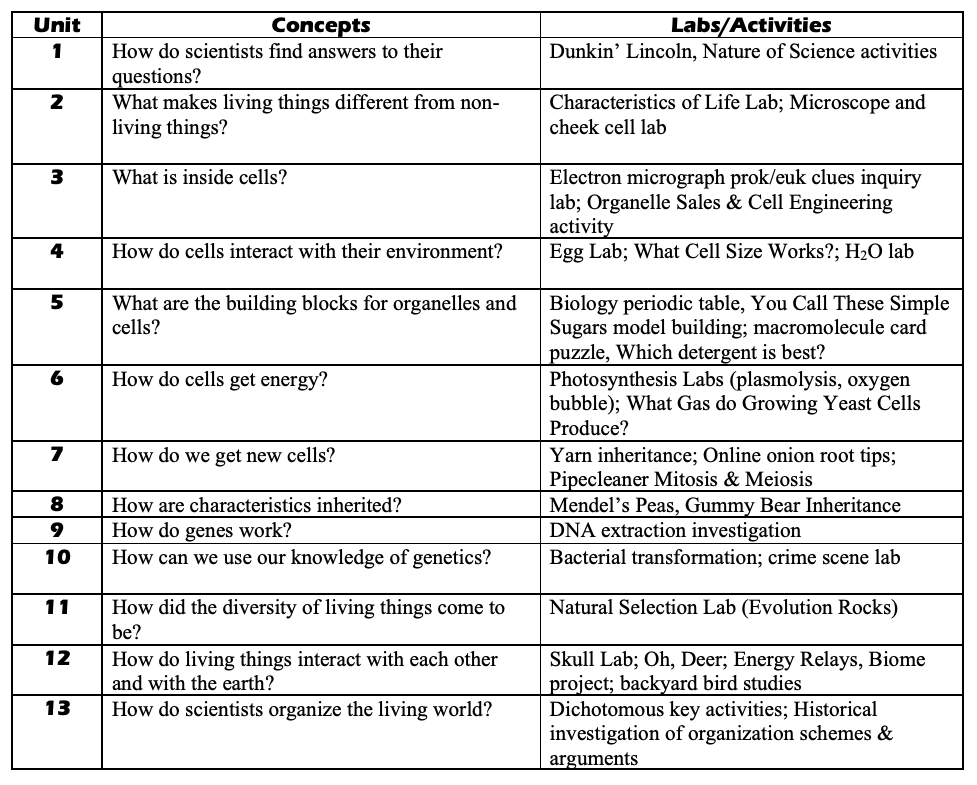
understand the concepts needed to answer the questions
Sadly, I found that my technically “essential” questions did not always perk up the interest of my students. I had to do a little more work to identify strategic questions that would connect these ideas to students’ everyday life, or challenge their assumptions when introducing the day’s work. Starting the day with such a question can help focus students on the why of what we are learning. This takes a bit of thinking and planning, but once you come up with a good question, it will work its magic over and over. One year I changed forever how I introduced my unit on cellular respiration by coming up with this little sequence of discussion questions to start the day:
How long can you live without food? – discussion ensues; they bring up examples of fasting and hunger strikes that they have heard of etc.; we decide a month or so, depending –
How long can you live without water? – more discussion, arrive at a week or so, depending –
How long can you live without oxygen? – students think about holding their breath, diving underwater etc. I prompt for further thought of how long once no more oxygen is circulating in the body? We agree on definitely minutes, likely a minute or so –
Now for the kicker question that will really be important for this unit: Why do we need oxygen so badly? What do we do with it? – no one knows this, they just say “so you won’t suffocate” but no one really knows why oxygen must be present in the air we breathe –
Now I have them: we’re about to learn why oxygen is so critical to our survival, and even how it changed life on earth! By the end of the unit, they will be able answer that last question with confidence. Now we have a real-world focus for learning about some very abstract concepts, which helps the work ahead seem worthwhile. You’ll see some more examples of these types of strategic questions identified in parentheses after the essential questions in the revised table below:
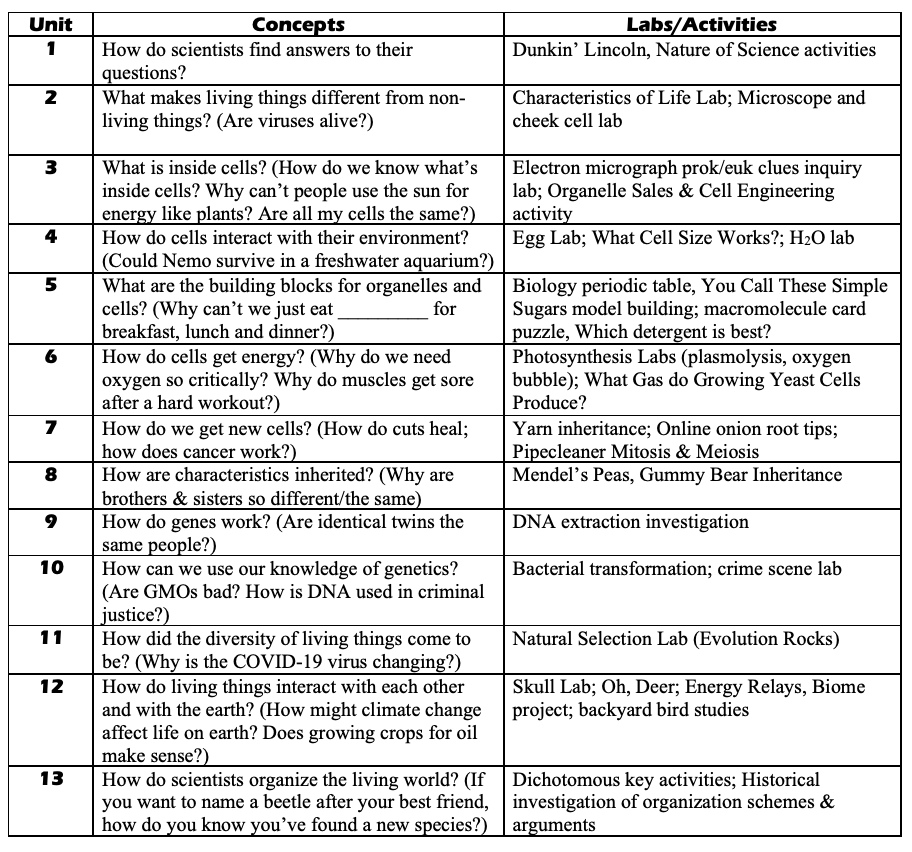
The essential questions we develop for each unit help drive lesson planning and focus our choice of activities. But the strategic focus questions we develop for students will provide a bridge between their lived experiences and our curriculum, like a key to unlock their curiosity and reveal their prior understandings. Maybe that’s a good name for them: Key Questions for our lesson plans. They make a great first step for taking some risks, shifting instruction for more discourse and connections for student engagement.
*Madeline Hunter’s ideas for standards-based direct instruction changed teacher lesson plans and guided their formal evaluations for decades, though that really wasn’t her fault if you read her original work…
 SciencEdLife
Brilliant as always Birgit, Thank you for inspiring experienced as well as new teachers to inspire their students.
LikeLike
Thank you Casey! Great to have your thoughts and appreciate the kind words 🙂
LikeLike